


Recommended combination

Product description
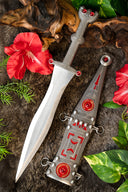
The silver Roman pugio was discovered in 2019 near Haltern am See in the German state of North Rhine-Westphalia. This location is often associated with the Roman military camp at Aliso, which played a crucial role during the Roman presence in Germania under Emperor Augustus. Haltern am See lies near the Teutoburg Forest, where the famous Battle of the Teutoburg Forest took place in 9 AD. Three Roman legions under Publius Quinctilius Varus were destroyed there by Germanic tribes led by Arminius.
The original pugio is richly decorated with silver inlay, indicating the high status of its owner—likely a Roman centurion. The fact that the weapon was found in a Germanic grave strongly suggests that it was taken as a war trophy by a Germanic warrior.
This find highlights the confrontations between Romans and Germans in the first century AD. It also illustrates how Roman military objects came to be found in Germanic contexts—as loot and as symbols of status. It represents the valour of Germanic warriors, who fought primarily in war bands.
The pugio was a Roman dagger employed in combat as a secondary weapon alongside the gladius. It was also a practical tool, and politicians would sometimes carry it as a symbol of office; Julius Caesar was famously assassinated with a pugio. Pugiones were constructed with a broad, leaf-shaped blade with a central rib. Later pugiones were narrower and featured a smaller central rib.
Product details
Product details:
Blade material: 420 stainless steel
Grip material: Die-casting
Scabbard: Die-casting
Blade length: 23.5 cm
Total length: 36 cm
Total length (with scabbard): 38.5 cm
Weight (without scabbard): 430 g
Weight (with scabbard): 830 g
Edge: semi-sharp
Shipment weight (grams): 1000


