


Recommended combination


Product description
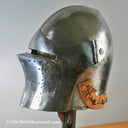
The helmet is based on an original from the Musée de l'Armée.
Between 1330 and 1350, bascinets with a flat visor attached on both sides of the helmet began to appear. This was likely a development of the klappvisier bascinet. This type of bascinet is depicted on tomb monuments and other visual or sculptural sources from the 1340s. One of the earliest examples can be found on the tomb monument of Sir Hugh Hastings († 1347) in St. Mary's Church in Elsing, Norfolk, England.
As with the originals, the visor hinges are fitted with a steel pin, making the entire visor removable. Hinge systems such as this were probably an Italian innovation.
The bascinet is constructed from 2 mm thick steel for additional protection. It comes with a textile liner and a chin strap to secure it in place.
Product details
Product details:
Max. head circumference: 60-61 cm
Material: Carbon steel
Thickness: 2 mm
Tempered: Yes
Inlay: Textile inlay
Based on a historic original: Yes
Shipping weight (grams): 3000


