


Recommended combination


Product description
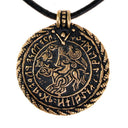
This pendant is modeled after the brackateate of Vadstena, a amulet from the Swedish migration period, found in Östergötland (Sweden) and dating from the 5th century. The original is in the Svenska Historiska Museet in Stockholm.
The Brakteaat shows a head on the back of an animal with a bird above it, surrounded by a runic inscription in the older Futhark which, when translated, reads approximately: 'I am called Hariuha, knowing of misfortune I bring good luck.' Presumably the bratteat was originally a decoration for the warriors of a leader, possibly even a jarl or king. The name brakteate comes from the Latin 'bractea' (thin plate): Germanic brakteates took Roman medallions as an example, but are different from those coins — only struck on one side and were mainly seen as bringing good luck amulet worn.
A meaningful pendant for those who want to depict the Germanic migration period.
Product details
Product details
Material: bronze
Dimensions: 3 x 3.5 cm


