


Recommended combination

Product description
Chainmail chausses were the standard form of metal leg protection in Europe from the 9th century until the early 14th century. They offered flexible protection against most weapons, but were gradually replaced by iron plate armour from the second half of the 13th century. The earliest examples date from the 9th century, such as a chainmail-covered foot discovered in the Kyulevcha catacombs in Bulgaria. Byzantine art depicts calf-length chainmail chausses in Tokali Kilise (10th century) and Karanlik Kilise (11th century). Full chainmail chausses were presumably already in use at the beginning of the 9th century and spread via the Danube or Italy, as may also be observed in the Stuttgart Psalter. One of the most renowned depictions in Western Europe appears on the Bayeux Tapestry (1066–1083), where William the Conqueror and other knights are shown wearing them. By around 1200, chainmail chausses had become almost standard equipment amongst knights and men-at-arms.
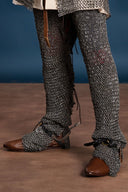
The pair of chain mail chausses is constructed from 1.8 mm wide natural flat rings with an inner diameter of 8 mm. The rings are woven four into one and riveted with wedge rivets. The chausses cover the entire leg. They are 118 cm long, 60 cm wide at the top and 46 cm wide at the bottom, and weigh 5 kg.
Product details
Product details:
Length: 118 cm;
Width top: 60 cm;
Width bottom: 46 cm;
Type of steel: Spring steel;
Steel thickness: 1.8 mm;
Inner diameter: 8 mm;
Riveted: Flat rings, wedge shaped rivets;
Weaving method: 4:1 construction;
Weight: 5 kg;
Based on a historic original? Yes;
Shipping weight (grams): 5500


