


Recommended combination


Product description
The cera (Latin for tabula cerata – wax tablet) was a small writing board crafted from a hard material such as boxwood, beech, or even bone. In the centre of the board was a recessed area filled with a layer of dark wax.
Writing on this wax layer was accomplished with a stylus – a pointed tool constructed from metal, wood, or bone (Greek: st?los, Latin: stilus). With this tool, characters were scratched into the wax. Where necessary, these marks could easily be erased or smoothed over, rendering the tablet reusable. These wax tablets were employed for daily notes, reminders of tasks, debts, obligations, and as drafts of texts that were later copied onto papyrus or parchment. Wax tablets were much cheaper to produce than papyrus or parchment, making them a particularly well-suited material for drafts.
Sealed wax tablets were also utilised for official purposes, such as drafting wills, transmitting secret orders, statements, receipts, and even reports. The oldest known archaeological example of a wax tablet dates back to the 7th century BCE, found in Etruria (Italy). In Europe, the use of wax tablets remained widespread until the mid-19th century.
Writing
Use the pointed end of the stylus to carve letters into the wax with light pressure in a downward motion.
Erasing
The flat side of the stylus is used to smooth the wax. Keep the stylus flat, place your index finger on the flattened side, and move it in a pulling (not pushing) motion over the wax. This permits the tablet to be reused repeatedly.
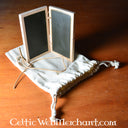
This replica wax tablet has two tablets. The wax is crafted from beeswax. The tablet measures 12 × 7 cm and comes with a cotton pouch.


