


Recommended combination

Product description
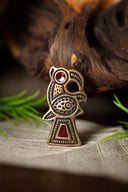
This Frankish bird brooch dates back to the middle of the 6th century AD and belongs to the Merovingian period. The original piece was crafted from gilded silver with red garnet inlays and was discovered in the grave of a wealthy Frankish woman in the Flemish village of Witternesse in the Pas-de-Calais. The brooch forms part of the collection of the Comtesse de Béhague. The replica of this bird brooch, like the original, measures 3.3 x 1.8 cm and is available in high-quality bronze. On the back, the brooch features a sturdy pin with a typical spiral construction.In the 5th and 6th centuries, bird brooches in the form of stylised eagles were part of the women's attire of the Frankish Merovingians. These ornaments, often worn in pairs, were a status symbol for wealthy Merovingian women. Together with another pair of brooches for the lower part of the garments, these four brooches formed the so-called Merovingian four-brooch costume, which was popular amongst the Franks and Alemanni in the early Middle Ages.
Small brooches with garnet inlays in the shape of eagles in profile were common in the 6th century in areas controlled by the Frankish Merovingians. These brooches, known as the Vorges type (named after a site in Aisne, northern France), date from 520–555 AD and have been found in northern France, the Rhine region, and southern Germany, with some variants appearing in England. They likely represented eagles and were originally modelled after the Roman imperial eagle. Such brooches symbolised a connection to the Roman Empire or Roman culture and were worn by women of high social status.
Product details
Product details:
Material: bronze
Dimensions: 3.3 x 1.8 cm
Based on a historic original
Shipment weight (grams): 50


