| Size | Chest circumference | Waist circumference | Hip circumference |
|---|---|---|---|
| S | 102-108 | 92-98 | 90-94 |
| M | 106-112 | 94-100 | 95-99 |
| L | 110-116 | 102-108 | 100-104 |
| XL | 116-124 | 108-114 | 105-109 |
| XXL | 124-132 | 114-122 | 110-119 |
| XXXL | 132-140 | 122-130 | 120-125 |


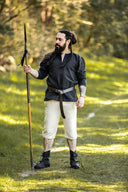


The knee-breeches have a long history and were already worn during the Roman Iron Age. Within the Germanic clothing tradition, both long, close-fitting trousers and shorter trousers reaching to the knee were in use. A notable example is the man of Obenaltendorf, a bog body from the 3rd century AD that was found in 1895 in northern Germany. Alongside a cloak, a sleeveless tunic and leather shoes, he wore woollen knee-breeches in combination with leg wraps; thanks to the preserving effect of the bog, parts of his clothing have survived. The knee-breeches also kept reappearing in later centuries and formed a fixed part of men's clothing during the Renaissance and the early Baroque.
These knee-breeches are made of handwoven cotton and have a straight, simple cut. The waistband features an elastic channel with a cord, so the trousers fit comfortably to size. The legs end at the knee and can be adjusted at the hem. Two side pockets offer room for small items.
This makes it a versatile garment for re-enactment and living history around the Germanic and early medieval periods, and equally useful for LARP, theatre or a day at a historical event.


