


Recommended combination

Product description
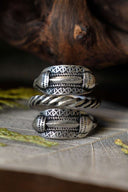
The ring was discovered in a 3rd-century Germanic cremation grave in Naustdal, Norway. Similar snake rings from the same period have been found elsewhere in Scandinavia, highlighting the vibrant contact that existed between the North Germanic world and the Roman Empire. Germanic tribes sent their warriors to serve as auxilia and foederati in the Roman armies, whilst active trade flourished between the two regions. This resulted in a North Germanic culture that, alongside its traditional Germanic objects, had developed a strong appreciation for Roman luxury goods.
Notably, the ring was intentionally broken during the cremation. It is possible that the wearer was a ritual specialist, similar to the later Volva. The ring may have possessed magical power, and its breaking was likely intended to ensure that it did not fall into the wrong hands.
The original is now held within the collection of the Norwegian Historical Museum in Bergen. Similar rings have been found in Himlingøje and Nordrup in Denmark. This replica is available in sizes S, M, and L.
The snake was a common motif in Roman art and jewellery, believed to protect the prosperity of the household.
In ancient Greek culture and the Nordic Bronze Age, the snake symbolised healing. The snake worship seen in Roman culture may have originated in Macedonia, where it was believed to be a symbol of fertility. For this reason, women gladly wore jewellery in the shape of a snake.
Product details
Product details:
Material: silvered bronze
Size: S t/m L (S: 17.3 mm ring size 52-58; M: 19.3 mm ring size 59-64; L: 21.3 mm ring size 65-70)
Based on a historic original
Shipping weight (grams): 10
Similar products
Related blogs

Pagan Symbolism: Germanic Oath Rings
Read more-

Who Was the Völva? A Journey to the Indo-European Roots
Read more -

European Shamanism: The Journey Between Spirits, Gods, and Nature
Read more -

The Migration Period: The Birth of a New Europe
Read more -

Roman Religions in Antiquity: Cosmic Order, Gods and Traditions
Read more -

The Ecstasy of the Völva: Rituals and Trance Reconstructed
Read more -

The Völva: Seeress, Staff-Bearer and Mistress of Magic
Read more


