


Recommended combination


Product description
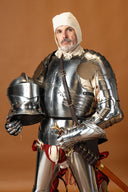
Cuirasses of this type originated during the late Gothic period (1440–1500). The Gothic style was characterised by sharp, highly decorated shapes. The design of this type of cuirass followed Burgundian fashion, ending around the thighs—just like the fashionable doublet of the time. Cuirasses of this kind were often worn together with chainmail voiders, an aventail (standard or bishop's mantle), and a chainmail skirt (gousset). The arms and legs were also fully armoured, and this style was complemented by pointed sabatons that imitated the shape of poulaines from contemporary clothing fashion.
Gothic armour was often worn in combination with a sallet and bevor, whilst the kettle hat also remained popular. This cuirass features an integrated plackart that provides additional reinforcement to the lower section of the armour, creating the characteristic central ridge. For extra mobility, faulds (articulated plates) at the front and culets (articulated plates at the lower back) are included. These features greatly improve leg movement and are especially useful whilst riding a horse.
The armour is constructed from 1.2 mm thick steel, and is therefore not suited to full-contact reenactment battles. However, it may be worn as part of a costume, for LARP combat, or employed as a decorative display piece. The cuirass consists of several articulated plates, rendering it highly flexible and comfortable to wear. It can be adjusted to size by means of the leather straps.
Product details
Product details:
Material: leather, steel
Thickness: 1.2 mm (18 gauge)
Length: 61 cm front, 73 cm back
Chest circumference: 120-140 cm
Neck opening: 18 cm
Weight: 8.5 kg
Delivery: cuirass and backplate
Based on a historic original
Shipment weight (grams): 10000


