


Recommended combination


Product description
From 1300 onwards the shape and strength of the sword changed rapidly, as the growing use of armour rendered a shield unnecessary. The grip and the blade became longer so that the sword could be employed with two hands, now that a shield was no longer required. The large swords were longswords that could only be used with two hands, and these were the predecessors of the later and even larger two-handed swords. Large swords were used solely by infantrymen. The shape of the blade was at first wide and flat, later becoming slimmer and more pointed, whilst the later point was made thinner to better pierce the armour.
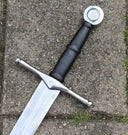
The sword has a length of 109 cm and a blade of 86 cm that is hand-forged of 9260 carbon steel. The width of the cross-guard is 20 cm. It weighs approx. 1.75 kg.
Product details
Product details:
Length: 109 cm;
Blade length: 86 cm;
Grip length: 20 cm;
Weight: 1750 grams;
Steel type: 9260 carbon steel 48 HRC.;
Edge: Edge 3 mm (battle-ready);
Tang construction: Full tang construction;
Pommel: Screwed;
Grip wrapping: Wood, leather;
Based on historical original: Yes;
Shipping weight (in grams): 3000
Similar products
Related blogs

-
Construction of a sword
Read more -
Safe use of battle-ready swords
Read more -
Types of steel and hardness levels
Read more -
What is a mock combat
Read more -
Weapons safely package
Read more -
Gloves in reenactment
Read more -
Responsible use battle-ready weapons
Read more -
Rust and prevention
Read more -
Check for mock combat
Read more


