


Recommended combination


Product description
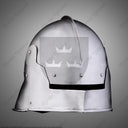
The sallet is based on a 15th-century original crafted in the German style. Sallets of this type emerged between 1450 and 1460 and were worn across Europe, being particularly popular in Germany, even amongst the aristocracy. The visor of this sallet is crafted in the late Gothic style, and the neck guard consists of multiple lamellae for increased mobility.
The German sallet may have resulted from a blend of influences from the Italian sallet and German kettle hats with wide brims and visors, which were employed in the first half of the 15th century. This sallet is constructed in the German style with a neck guard composed of several lamellae.
Sallets existed in many variants, reflecting the needs of the wearer. This type was developed for infantry, as it can be combined with a high gorget. Often, they were quickly and mass-produced during wartime, as many were needed immediately.
Sallets of this kind were typically worn with a bevor, but sometimes with a gorget or without additional neck protection. This sallet can be worn in five different ways, with or without a bevor:
-
Sallet half over the head – optimal field of vision.
-
Sallet half over the head with bevor closed – optimal vision with extra facial protection.
-
Sallet flat on the head with visor open – optimal vision, useful for issuing commands in battle.
-
Sallet flat on the head with visor open and bevor closed – slightly reduced vision but added facial protection.
-
Sallet flat on the head with visor closed – maximum protection for head and face.
The sallet features a movable visor and a long neck guard. With a steel thickness of 1.6 mm, it is well-suited to reenactment.
Product details
Product details:
Material: steel, leather, canvas
Thickness: 1.6 mm
Includes canvas helmet inlay
Max. head circumference 63-64 cm
With chin strap
Based on a historic original
Shipment weight (grams): 3000


