


Recommended combination


Product description
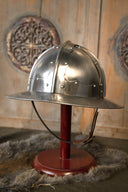
Kettle hats of this type emerged during the Crusades, around the late 12th to early 13th century. The helmet may have been adopted from Byzantine armies, who wore similar helmets with longer brims. They were worn alongside nasal helmets. Like spangenhelms, these helmets were constructed from multiple pieces. The type remained in use until the early 14th century, and various versions are depicted in the Maciejowski Bible from 1250. Multi-piece kettle hats were well-suited to infantry, as they were inexpensive to produce and could be repaired during campaigns.
The type proved so effective that even aristocrats wore it. The brim provided protection against downward blows and projectiles. The helmet offers a clear field of vision, good hearing, and optimal protection. By the early 14th century, the kettle hat had evolved into more advanced forms crafted from a single piece of steel, with a sloped brim that deflected projectiles from above, reducing impact on the helmet and head.
The helmet is crafted from 1.6 mm thick steel and features an adjustable leather liner.
Product details
Product details:
Material: carbon steel 1.6 mm
Inlay: leather inlay
Max. head circumference: 61 cm
Width ear to ear: 17.5 cm
length from front to back of the head: 21.5 cm
Based on historical original
Shipment weight: 3 kg.


