


Product description
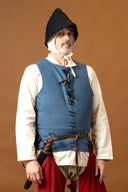
The Pourpoint was a garment worn by noblemen in the late 14th century, both in civil and military situations. It marked an important change in Western fashion, as it led to a shift away from the rectangular silhouettes of old medieval clothing towards the more refined attire of the modern period, which began to develop in the 15th century. The Pourpoint was originally conceived as a military garment, cut at the waist to prepare the body for the breast harness, which rested between the ribs and the pelvis. This ensured that the weight of the harness was redistributed from the shoulders to the hips.
Rather than bearing the full weight of the harness upon the shoulders, late medieval knights chose to distribute the weight of their armour across their bodies. In time, this garment was also adopted by nobles in their daily lives as outerwear worn over the tunic, eventually replacing it altogether.
This pourpoint is well-suited to medieval reenactment. It features 7 pairs of aiglets around the waist and 2 pairs of aiglets for attaching bones. The pourpoint is crafted from 100% recycled wool and lined with 100% linen. Please note: the images show a whole linen version, whilst this is a woollen version. The blue wool is slightly darker.
The fibres of wool trap air, making it a natural insulator that helps you remain warm.
It is breathable, which means that it keeps you warm without overheating.
Wool retains warmth even when wet and can repel water, making it a sound choice for wearing during rain.
Whilst it is not watertight, wool can absorb up to 30% of its weight in water before it feels wet, allowing you to stay dry in the rain for longer.
It is a durable material.
Wool is naturally flame-retardant and safer to wear than polyester during living history or historical events with campfires for warmth and cooking.
Detailed
Material: 100% recycled wool with a lining of 100% linen;
Colour: blue;
Sizes: S to XXL;
Wash: hand wash at cold temperature or use a delicate washing programme in the machine;
Drying: air dry by placing flat in the shade to retain colour and shape.;
Ironing: iron at a low temperature if necessary, or use steam to remove creases.;
Stain cleaning: Carefully dab with a damp cloth and mild soap for small spots.;
Based on historical originals


