


Recommended combination


Product description
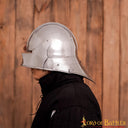
The German sallet is based on an original from 1480 crafted in Nuremberg in the German style. Sallets of this type emerged between 1450 and 1460 and were worn throughout Europe—especially in Germany, where they became immensely popular, even amongst the aristocracy. Both noblemen and foot soldiers were frequently equipped with sallets. In some cases, sallets were mass-produced prior to military campaigns. The visor of this sallet is constructed in the art style of the late Gothic period, and the neck guard consists of several lames to permit greater freedom of movement. This deluxe sallet also features a liftable visor.
The German sallet may have developed as a fusion of influences from the Italian sallet and the German kettle hats with wide brims and visors that were employed during the first half of the 15th century. Sallets of this type were most commonly worn in combination with a bevor, though sometimes with a gorget—or even without additional neck protection. The sallet may be worn in five different ways, with or without a bevor:
-
Sallet worn halfway back on the head: provides an optimal field of vision.
-
Sallet halfway back with the bevor closed: offers an optimal field of vision with added facial protection.
-
Sallet fully on the head with the visor open: ensures excellent visibility and permits the wearer to call out commands during battle.
-
Sallet fully on the head with visor open and bevor closed: provides slightly more visibility than when the visor is closed.
-
Sallet fully on the head with visor closed: offers maximum protection for the head and face.
The interior of the helmet features an adjustable textile liner and a chin strap for a secure and comfortable fit.
Product details
Product details:
Material: carbon steel;
Max. head circumference: 68 cm;
Steel thickness: 2 mm


