
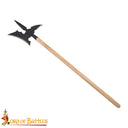


Product description
The halberd is based on originals from the 16th–17th century. A pole weapon comprising a long wooden shaft and an iron tip, with an axe blade and a hook below, it is perhaps misunderstood more than most medieval arms. Contrary to common belief, the hook was not intended to enlarge wounds but rather to block or trap enemy weapons.
Owing to its length, a halberdier could strike with considerably greater force than was possible with a sword. The weapon proved highly effective in attack, particularly against cavalry, whilst remaining less well-suited to defence. Skulls split completely by a halberd have been discovered on battlefields such as Wisby (1361) and Towton (1461).
With the rise of firearms, the halberd disappeared from the battlefield, yet remained in use for ceremonial purposes. The most celebrated example is the Swiss Guard in Vatican City, who still carry halberds today, though no longer in combat.


