


Recommended combination


Product description
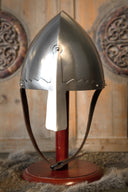
From the mid-11th century, nasal helmets of this kind were crafted from a single piece. This rendered them sturdier, though also more expensive than the spangenhelm, which was constructed from multiple parts. These nasal helmets remained universally conical until the early 12th century, and helmets of this type continued to be employed across Europe until the end of the 12th century. In medieval manuscripts, nasal helmets such as these are notably always depicted in combination with a chainmail coif.
Medieval helmets of this type are depicted on the Bayeux Tapestry, and were worn by knights during the Crusades. The design proved particularly popular amongst warriors of the period, as it offered good visibility whilst still protecting the nose and face by means of its long nasal piece.
Product details
Product details:
Max. head circumference: 62 cm
Material: Carbon steel
Thickness: 1.2 mm
Inlay: equipped with helmet inlay
Based on a historic original
Shipment weight (grams): 3000


