


Recommended combination


Product description
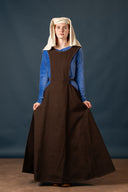
The surcotte, originally worn as an outer garment by men, became more popular amongst women from the thirteenth century onwards. The garment has been designed to be worn over another piece of clothing. Wide, sleeveless surcottes were worn by the working class, whilst narrow surcottes were favoured by the aristocracy. Narrow surcottes such as this one emerged in the 14th century and were sometimes considered a controversial garment. This type of surcotte arose during a period of sexual liberalisation.
The armholes of the surcotte grew increasingly larger, becoming a notable fashion statement. Eventually, the openings reached the hips, as with this surcotte, permitting the underdress beneath to be seen. On account of this, the fashion trend drew criticism from certain moralists. The medieval church deemed this fashion immodest, calling the armholes 'the gates of hell.' Nevertheless, the narrow surcotte continued to be worn well into the 15th century and was even a garment of state from 1525 onward.
The surcotte is crafted from sturdy cotton canvas, rendering the garment well-suited to spring and autumn. The hems feature a finely woven cotton rib. The armholes reach to the hips. The surcotte is best combined with a belt and shift dress. A distinctive garment for re-enactment and LARP of the thirteenth to fifteenth centuries.
Product details
Product details:
Material: 100% cotton
Length: approx. 150 cm
Colour: brown
Size: S/M, L/XL, XXL (see size chart below)
Washing instructions: hand wash or hand wash cycle machine
Based on a historic original
Shipping weight (grams): 1000


