
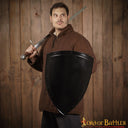


Recommended combination
Product description
The knight's shield, or heater shield, developed around the end of the 12th century from the Norman kite shield. Heater shields owe their name to Victorian historians, who associated the shield's shape with a Victorian flat iron. These shields were considerably smaller than the earlier Norman kite shields, offering less protection to the left leg whilst being far more manoeuvrable. At the beginning of the 13th century, heater shields were used alongside the large Norman kite shields. Later, only heater shields and bucklers were employed. These shields remained in use on the battlefield until the 14th century and continued to be employed afterwards for tournament purposes.
The shield is based on medieval kite shields depicted in manuscripts and on tapestries. It features a blackened finish, which prevents rust and also renders it particularly well-suited to painting. The Templar Knights employed heater shields such as this one in combination with swords during combat. Such shields were relatively compact, making them convenient for knights on horseback. Shields of this type were utilised during the Crusades. The back is equipped with a strap and handle for easy carrying.
Product details
Product details:
Material: mild steel;
Thickness: 1.2 mm (18 gauge);
Finish: blackened;
Height: 60.9 cm;
Width: 46.9 cm;
Includes strap and handle


