


Recommended combination


Product description
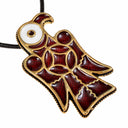
This pendant is based on an Ostrogothic eagle fibula from the 5th-6th century. A pair of these fibulae was found in 1888 in a mausoleum on the Via Flaminia near Rome and is decorated with cloisonné on gilt silver foil, originally with almandine and rock crystal; This pendant is equipped with red and white glass enamel, where the underlying cell work comes into its own.
In archeology, the eagle is considered a characteristic motif in the customary art of the Goths, from the Black Sea and the Danube region to Italy and Spain. After the conquest of southern Russia, the motif was adopted from Sarmatian examples from the second half of the 4th century, possibly in connection with the early Christianization of the Goths: in early Christianity the eagle was considered a symbol of heaven and the resurrection.
A beautiful pendant for those who want to portray the Ostrogothic or early medieval Germanic culture.
Product details
Product details
Material: bronze
Dimensions: 4.5 x 3 cm


