


Recommended combination


Product description
The lorica squamata, or scale armour, was likely adopted from the Scythians or Sarmatians and was in use as early as the 6th century BC. The lorica squamata was a Roman body armour worn by signifiers (standard bearers), aeneatores (trumpet players), centurions, cavalry, auxiliaries, and regular legionaries. Even emperors were sometimes depicted wearing it. During the Dacian Wars, Emperor Trajan was obliged to re-equip some soldiers in lorica segmentata with lorica hamata or lorica squamata. The exact introduction remains unknown, but it remained in use for approximately eight centuries, particularly in the 1st and 2nd centuries AD. An original example of the lorica squamata was found in Satala, Turkey. The lorica squamata continued to be worn well into the 5th century, after the fall of the Roman Empire.
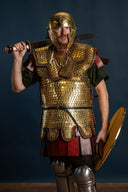
This high-quality reproduction of a lorica squamata is handmade and fully wearable. It consists of overlapping cast brass scales, each approximately 0.4 cm thick with a midrib. The scales are threaded together in horizontal rows and sewn onto a sturdy brown cotton canvas backing, creating a dense pattern resembling fish scales. The sleeveless torso and back armour are finished with sturdy brown leather and feature two leather straps with brass buckles on each side, rendering it adjustable to a wide range of sizes. It reaches just below the hips and has a scalloped bottom edge and a round neckline with a back slit opening. The torso and back armour come with an additional layer of shoulder protection. This fully removable shoulder armour, also consisting of brass scales sewn onto fabric and bordered with stitched leather, is fastened with a brass clasp at the front and adjustable with four leather straps and brass buckles at the back.
Product details
Product details:
Material: scales, buckles and fittings made of brass, edge finishing and straps of vegetable-tanned leather, back of brown canvas (100% cotton)
Scale size: approx. 35 x 25 mm
Scale thickness: approx. 0.4 / 0.5 mm (26 / 24 gauge)
Total length: approx. 70 cm (measured fully extended from the highest shoulder point to the bottom hem)
Dimensions of the doubling: approx. 63 x 54 cm (when fully extended)
Chest circumference: approx. 125 to 135 cm, adjustable with straps and buckles
Weight: approx. 10.3 kg
Based on a historic original
Shipment weight (grams): 12000
Shop the look


