


Recommended combination


Product description
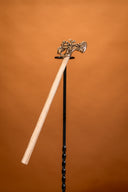
The bronze axe is a replica of a Scythian sagaris. Battle axes of this kind were employed throughout the Scythian world between the 9th and 3rd centuries BC. The sagaris was a formidable weapon that could be wielded both on horseback and on foot. Other steppe peoples, such as the Medes, Persians and Parthians, also made use of the sagaris, as did the Indo-Scythians. The weapon was also employed by Scythian mercenaries who served in the Greek and Persian armies.
This sagaris is decorated with the motif of a double-headed eagle. This motif originated in ancient Mesopotamia and was adopted in the Bronze Age by the Indo-European Hittites, the Greek Mycenaeans and later by the Indo-Iranian peoples from whom the Scythians emerged. The edge of the axe ends in a boar, a common motif in Scythian art.
The back of the axe blade is decorated with a Chimera. This mythical creature originated in the Greek Archaic period (ca. 800–700 BC) and was possibly influenced by Hittite art. It is likely that the Scythians incorporated the Chimera into their own culture in this way.
Product details
Product details:
Material: ash wood, bronze (lost-wax method);


