


Recommended combination


Product description
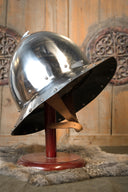
At the end of the 14th century, the kettle hat gradually developed towards the cabasset. This permitted even better protection for the head whilst retaining its characteristic brim. The sloping brim helped to deflect blows and projectiles, preventing the full impact of an attack from striking the helmet and head directly.
This type of helmet was so effective that even aristocrats wore it. The brim offered additional protection against downward strikes and projectiles, whilst the helmet still provided an excellent field of vision, good hearing, and optimal protection. Kettle hats such as these were worn by armies across Europe from the second half of the 15th century and remained popular well into the 16th century.
The kettle hat is a replica of a 15th-century example depicted in various Spanish manuscripts. Helmets of this kind came into use in the 15th century and continued to be worn well into the 16th century.
Constructed from 2 mm thick steel (the brim is 1.6 mm thick), it features a linen lining and a chin strap with a historically accurate buckle.
Product details
Product details:
Max. head circumference size M: 61 cm
Material: Carbon steel
Thickness: 2 mm (the edge is 1.6 mm)
Inlay: Textile inlay
Based on a historic original: Yes
Shipping weight (grams): 3000


