


Recommended combination
Product description
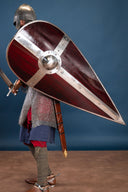
This type of shield is based on originals depicted in the Bayeux Tapestry (1066), the Codex Aureus Epternacensis (early 11th century), and the chronicle Liber ad honorem Augusti sive de rebus Siculis (1196). Shields of this type were likely introduced by the Normans and, following the First Crusade, were employed by Christian, Byzantine, and some Islamic armies. The shield offered excellent protection and was used by both cavalry and infantry. During long marches, it was often carried on the back, sometimes upside down.
In the second half of the 12th century, these shields were gradually replaced by shields with flat tops. Early examples, such as this one, often still featured a shield boss — a tradition carried over from the round shield, behind which the grip was mounted. On kite shields, the boss no longer served this practical purpose, yet it permitted the shield to be utilised as a weapon in combat, enabling the soldier to deliver a thrust with the boss.
The shield is crafted from 1.3 cm thick wood with a steel boss and cross reinforcement. The back is fitted with five leather straps for comfort. It measures 139 cm in height, 60 cm in width, and weighs 4.5 kg.
Product details
Product details:
Length: 139 cm
Width: 60 cm;
Material: Plywood;
Thickness: 1.3 cm;
Based on a historic original: Yes;
Shipping weight (grams): 10000
Shop the look


