

| Size | Chest circumference | Arm length | Back length |
|---|---|---|---|
| S | 105 | 28 | 78 |
| M | 113 | 28 | 78 |
| L | 121 | 28 | 78 |
| XL | 129 | 28 | 78 |
| XXL | 137 | 28 | 78 |
| XXXL | 145 | 28 | 78 |


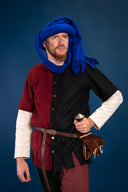


Discover the new Mi Parti collection from Burgschneider! The surcoat Aleran consists of two halves that are sold separately, allowing a mi parti surcoat to be assembled as desired. The left side may be fastened to the right side by means of the buttons. For those who are members of different medieval LARP and reenactment groups, a great many different colour combinations can be achieved with just a few left and right sides. The surcote is a garment that dates back to the 12th century. It was worn above the other clothes, featuring a wealth of heraldry and decorative elements, and served to distinguish friend from foe clearly in the heat of battle. The Surcoat "Aleran" is crafted from a heavy wool fabric with a deep colour, well-suited to all weather conditions. From the 11th to the 16th century, the "mi-parti" (partially coloured) style of dress was popular amongst those who wished to join two different coloured fabrics at the middle. The effect is a colour contrast that often creates a dramatic look. During the Middle Ages, mi-parti was an important style amongst cloaks, tabards, dresses, trousers and gowns. The earliest examples of this style date back to the 9th and 10th centuries, where the split colours were employed on legs and shoes — the boots being half one colour and half the other. In the High Middle Ages, the mi parti style grew in popularity as colour symbolism in clothing became increasingly important. The colours often stood for a certain status or a particular connection. The style became more common in the 13th and 14th centuries, when many men — especially vassals — imitated the coats of arms of their feudal lords. Towards the end of the 16th century, the style gradually declined.


