


Recommended combination


Product description
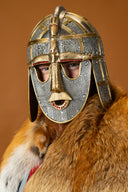
The original helmet was discovered in 1939 at the English town of Woodbridge during archaeological research into the Saxon boat grave of Sutton Hoo. It is now part of the collection of the British Museum in London. The helmet shows similarities with the 7th-century helmets found in Vendel (Sweden), and is furnished with late Roman neck and cheek flaps; the engravings of the helmet and the grave in which it was found give the impression that it was the property of a Saxon king or chieftain.
The helmet is a realistic replica of the original. Amongst its most notable features, just as with the original, it is inlaid with decorated iron plates upon which Saxon knot motifs, warriors, horsemen, and what appears to be a religious ritual are depicted. The plates are attached to one another with metal strips. Much like the Vendelhelm, the Sutton Hoo helmet has a crest running along the middle, which terminates in a dragon motif ornamented with red enamel.
The helmet is furnished with a leather inlay for added wearing comfort and is constructed from 1.3 mm thick steel. It is battle-ready and is well-suited to a head circumference of up to 61 cm. It weighs approximately 2.85 kg.
This helmet is a museum replica.
Product details
Product details:
Length (front to back): 21.5 cm
Width (ear to ear): 17.5 cm
Max. head circumference: 61 cm
Material: Carbon steel
Thickness: 1.6 mm
Inlay: Leather inlay
Weight: 2.5 kg
Based on a historic original: Yes
Shipping weight (grams): 3000
Similar products
Related blogs

The Horned Spear Dancer: From Shaman to Odin
Read more-

Pagan Symbolism: The Viking Wolves and the Cult of Odin
Read more -

Odin in Indo-European Context – The Divine Blueprint
Read more -

About the Kóryos
Read more -

The Germanic Dragon: From Venomous Worm to Guardian of Gold
Read more -

The Anglo-Saxons: The Founders of the English Kingdom
Read more -

Maintenance of steel and metal
Read more -

Viking Animism: A world full of hidden powers
Read more


