


Recommended combination


Product description
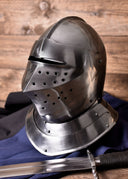
At the end of the 15th century, the close helmet evolved from the armet and later versions of the sallet. This type of helmet closely resembles the armet and remained a symbol of European aristocracy until the early 17th century. It was worn in state portraits, during tournaments, and on the battlefield by heavily armoured cuirassiers armed with rapiers and wheellock pistols. As the practical duties of the aristocracy were increasingly carried out by officials, young nobles could fully devote themselves to tournament riding and hunting. Helmets such as these were technological marvels, equipped with multiple visors to protect the face from incoming lance splinters.
Like the armet, the close helmet completely enclosed the head. Whilst it visually resembled the armet, it opened in a completely different manner. Like the armet, the close helmet followed the contours of the head and neck, narrowing at the throat, which required a mechanism to open and close it. Whereas an armet opened sideways via two large hinged cheekpieces, the close helmet opened vertically by means of an integrated rotating bevor attached at the same pivot points as the visor. The moving parts were usually locked with twist clasps that fell into perforated brackets, or with spring-loaded pins. The bevor was often secured with a strap.
The helmet is constructed from three main parts. It features a liftable visor that permits an optimal field of vision and can be easily placed on the cuirass.
Product details
Product details:
Material: carbon steel 1.2 mm
Inlay: leather inlay
Max. head circumference: 63 cm
Width ear to ear: 23 cm
length from front to back of head: 18 cm
Based on historical original
Shipment weight: 3 kg.


