


Recommended combination


Product description
A maul is a type of war hammer with a heavy head. The example featured here carries a spike-like point, though it is broader than that of a horseman's hammer — another type of war hammer. From the late 14th century onward, the weapon was employed mainly by infantry. During the Paris uprising of 1382, the rebels seized 3,000 mauls from the city's armoury; as a result, they became known as the Maillotins. Later that same year, the chronicler Froissart mentioned mauls in the Battle of Roosebeke, demonstrating that it was not solely a weapon of the common people.
A notable use of the maul occurred amongst archers in the 15th and 16th centuries. During the Battle of Agincourt, English longbowmen reportedly utilised lead mauls — initially as tools to drive stakes into the ground and later as improvised weapons. Other contemporary sources also mention their use. In England, such weapons were employed by Tudor archers until around 1562.
From the 15th century onward, shorter war hammers were increasingly used by cavalry. At first, nobles looked down on the weapon because of its origins amongst common soldiers, but they later adopted it for its practicality. Cavalry commanders sometimes carried war hammers both as weapons and as symbols of rank; these were known as Rottmeister hammers or Packmaster hammers. In Landsknecht armies and in parts of Central Europe, hammers also became status symbols for the lower nobility — almost equivalent to the sword. According to some sources, a nobleman would never leave his house without his sword and war hammer, which could also serve as a walking stick.
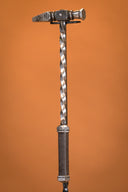
The hammer is hand-forged from steel and features a twisted shaft. The grip is wrapped in dark brown leather, and the hammerhead is double-riveted for extra durability. It measures 45 cm in length, 15 cm in width, and weighs approximately 1 kg.
Product details
Product details:
Length: 45 cm
Size blade: 15 cm;
Weight: 1000 g
Material: 9260 carbon steel
Edge: Blunt 2 mm (battle-ready)
Including shaft: Yes
Based on a historic original: Yes
Shipping weight (grams): 3000 This item cannot be sold to Belgium due to the Belgian weapons law.


