


Product description
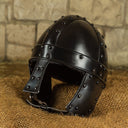
A fine helmet for Viking reenactment. The Spangenhelm is inspired by the helmets worn by the Vikings. The helmet is equipped with cheek valves, a further development from Roman helmets. The helmet features a nose piece that offered protection to the entire face without hindering the field of vision.
Details:
Max. Main circumference: 56-58 cm (s) & 58-66 (L)
Material: carbon steel
Thickness: 1 mm
Stake: with Helminalleg
Finishing: bronze (black)
Based on a historical original
Dispatch weight (gram): 3000 *
This article is produced in a limited edition. Every copy is unique, which permits sizes and finish to deviate slightly from one another.
Maintenance & Care
Prevent rust by oiling your armour regularly. If necessary, rust may be easily removed with black sandpaper.
Choose the best size
Do you wear a wambuis cap under your helmet? Then add 3.5 cm to your head circumference.
Are you wearing a maili-hood under your helmet? Then add 2.5 cm to your head circumference.
When wearing both a wambuis and a maliënkap under your helmet, 6 cm must be added to your head circumference.
The armour is 1 mm thick and well-suited to LARP battles, costumes and cosplay.
Tip: how to adjust the owner's finish and weapons
Luxury (polished) – Polish the steel with a metal polishing agent or toothpaste. With this method, an article may even be polished further. First test on a small surface!
Handmade (matt) – Place the steel for 40 minutes to 20 hours in cola. Check the matt finish regularly. Equalise the finish with black sandpaper.
Antique (patinated) – Place the steel for a whilst in a damp environment (preferably outdoors) and allow it to rust. Brush the red layer of rust away; the corroded top layer remains.
NB. After completing the product yourself, guarantee and return rights lapse. Celtic Webmerchant is not liable for the elaboration of the aforementioned methods.
Packed with 100% recycled material
When packing this article, only 100% recycled plastic and recycled paper/cardboard extracted from FSC-certified forests are employed. A large part of the material is reused directly without the intervention of a recycling process. Recycle the material by separating your waste.
1. Cardboard: separate or reuse paper.
2. Plastic cushions, clothing bags and plastic tape: separate or reuse plastic. If required, pierce the cushions with a needle for volume reduction.
3. Paper packaging for jewellery and small items: these have a plastic inner layer. Remove this, then separate paper and plastic.


