


Product description
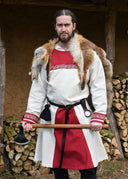
Viking tunics of this type were worn between approximately the eighth and eleventh centuries. The tunic is well-suited to re-enacting Vikings from northern Europe, Rusvik Vikings and Normans.
Particularly distinctive to this tunic is the hem, which consists of several strips of fabric sewn together, creating a wide volume. This technique is based upon various excavations of historical clothing fragments, including those at Haithabu and Viborg (Denmark). Viborg was situated on the military road that ran through Jutland to Central Europe. The name of this place suggests that there was a holy site in the Viking age. Vi is an old word for holy place and borg meant fortification or hill — thus 'the holy place on the hill'.
The tunic is crafted from sturdy cotton and features beautifully embroidered patterns at the neck and at the ends of the sleeves. These patterns are based on knot motifs found on the Stone of Stora Hammar on the island of Gotland, Sweden. This stone depicts mythological and warlike scenes, such as a sacrifice and Viking ships with warriors.
The tunic is composed of two contrasting colours, creating a striking effect. It is recommended that the tunic be worn with a belt.


