


Recommended combination


Product description
Hoplites were the heavily armed infantrymen of the ancient Greek army. The most important weapon was the lance (dory), whilst the most important means of defence was the large round shield (aspis). The xiphos, or sword, was a secondary weapon that hoplites carried on the left side. The xiphos is a relatively short sword (the blade averaged 45–60 cm in length) with a leaf-shaped blade. Xiphoi were employed primarily when the spear was broken, or in close combat, for thrusting and cutting. The early xiphos was crafted from bronze, and the later variants from iron. Few originals have been found; they are best known from images on Greek vases and sculptures.
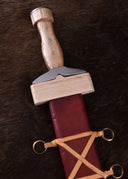
The xiphos is not an exact replica of an original, but has been designed based on excavated remains of various originals and on images in Greek art. The leaf-shaped blade is typical of xiphoi from the 6th and 5th centuries BC. The blade is constructed from EN45 steel with a wooden hilt, and the grip is riveted on the tang. The xiphos is supplied with a fine luxurious red leather scabbard with a wooden core. The top and bottom of the scabbard are crafted entirely from wood. The scabbard is further decorated with leather laces and has brass rings to permit it to be worn on the belt. This sword is a genuine asset for collectors of classical weapons and re-enactors of Greek antiquity.
Product details
Product details:
Material: EN45 steel, wood, leather
Length: 68 cm
Blade thickness: 1 mm (semi-sharp), suitable for decorative use only
Blade length: 54 cm
Length hilt: 14 cm (grip approx. 9 cm)
Maximum blade width: 9 cm
Point of balance: approx. 14 cm below hilt
Delivery incl. leather scabbard
Weight: 0.85 kg (1 kg with scabbard)
Based on a historic original
Shipping weight (grams): 2000
Similar products
Related blogs

The Greek xiphos in Antiquity: function, history and characteristics
Read more-

Introduction: The Hoplite – The Backbone of the Classical World
Read more -

Hoplites training & symbolism: The birth of the scholar-athlete
Read more -

Ancient Greece: From Mycenaean Palaces to Hellenism
Read more -

Get the Look: Early Classical Hoplite, 500 BC
Read more -

Get the Look: Athenian Hoplite
Read more


