


Recommended combination


Product description
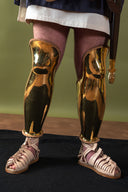
The greaves are modelled after two originals from the British Museum collection. Greaves such as these were worn, amongst others, by Greek hoplites. The original pieces were crafted from bronze.
From the first half of the 16th century, the subarmalis and other classical armour pieces came back into fashion. During the Renaissance, classical antiquity received special attention, leading to a new development in plate armour: the al antiqua style. This style is characteristic of the cinqueda, barbute, and armour with decorative curves. Italian knights wearing classical leg guards, subarmalis, and breastplates may be seen in murals and paintings from this period.
These brass greaves are 52 cm long and well-suited to a knee circumference of up to 39 cm. They weigh 1.9 kg.
Product details
Product details:
Length: 52 cm, length lower leg 39 cm;
Material: Brass;
Steel thickness: 1.3 mm;
Based on a historic original: Yes;
Weight: 1.9 kg;
Shipping weight (grams): 3000
Shop the look


Similar products
Related blogs

About ocrea (greaves in classical antiquity)
Read more-

Introduction: The Hoplite – The Backbone of the Classical World
Read more -

Hoplites training & symbolism: The birth of the scholar-athlete
Read more -

Ancient Greece: From Mycenaean Palaces to Hellenism
Read more -

Roman Gladiators: Warriors, Slaves and Superstars
Read more -

Get the Look: Early Classical Hoplite, 500 BC
Read more -

The Hoplite and the Polis – The Etruscan Warrior Culture
Read more


