


| Size | Hip circumference | Leg length | Cuff circumference |
|---|---|---|---|
| S | 85 | 74 | 40 |
| M | 95 | 74 | 40 |
| L | 101 | 75.5 | 40 |
| XL | 113 | 75.5 | 40.5 |
| XXL | 125 | 75.5 | 40.5 |
| XXXL | 135 | 75.5 | 41 |


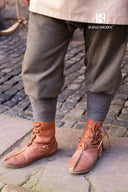


The herringbone pattern is a historical weaving method that was employed throughout early medieval Europe and still occurs today. Archaeological finds show that Vikings wore fabrics utilising this weaving method. Textile fragments with a herringbone motif have been excavated, for example, in the historical Viking towns of Hedeby, Birka, Jorvik (Coppergate and Lloyds Bank) and in London. The herringbone design gives these trousers a very historically correct look and is an asset to Viking re-enactors.
These trousers are constructed after the historic Rusvik model and have short legs. The model of the trousers can be emphasised further by wearing leg wrappings, as shown in the photo. By utilising a contrasting colour of leg wrapping, one can adjust the trousers to one's own wishes.


